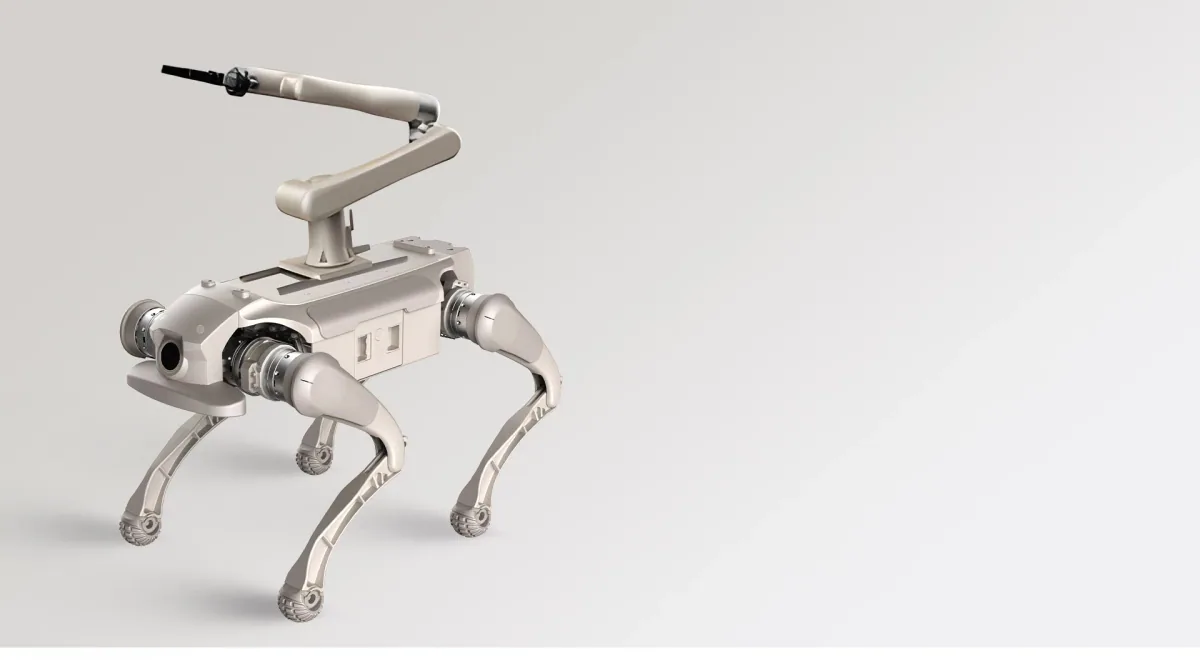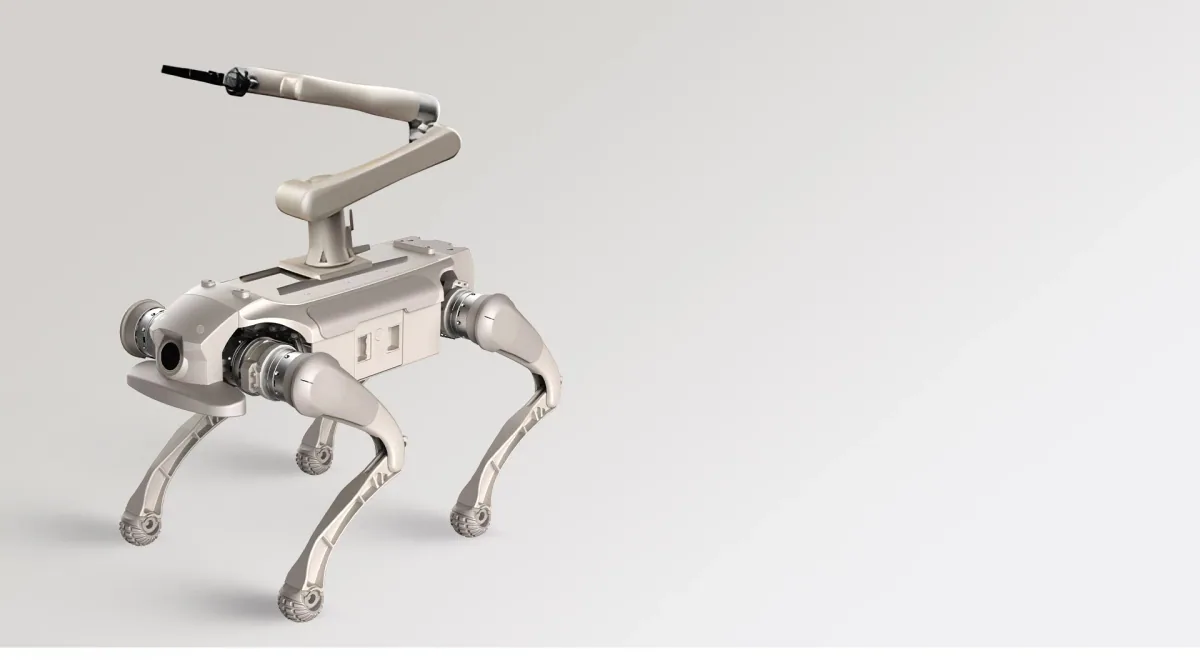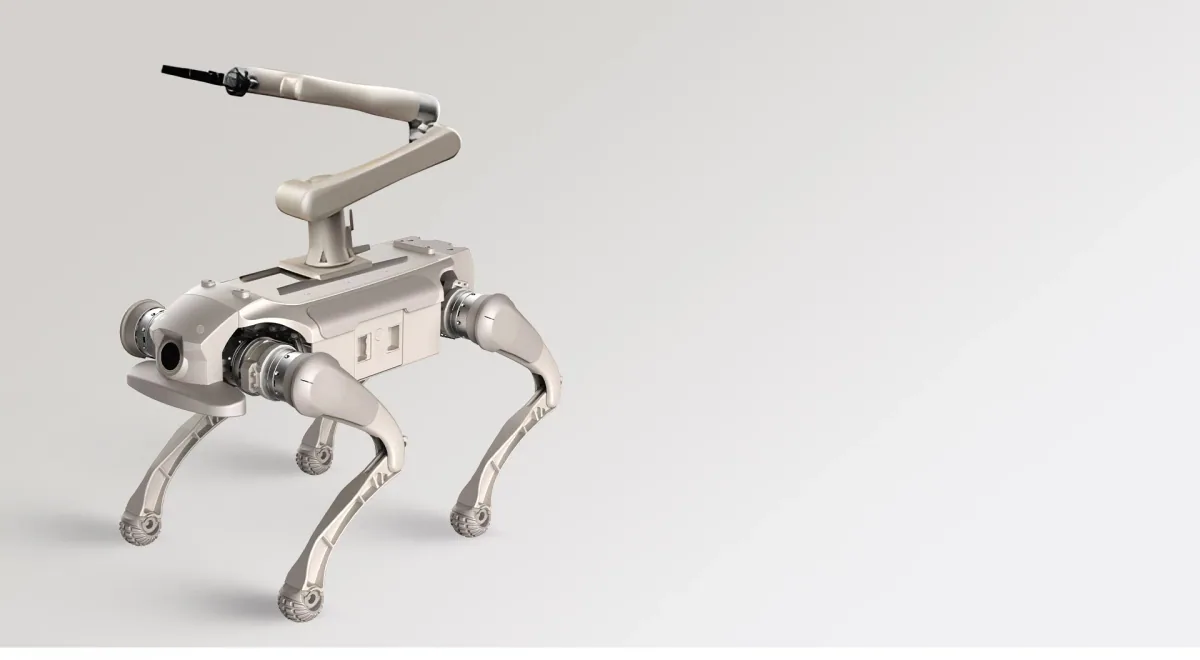
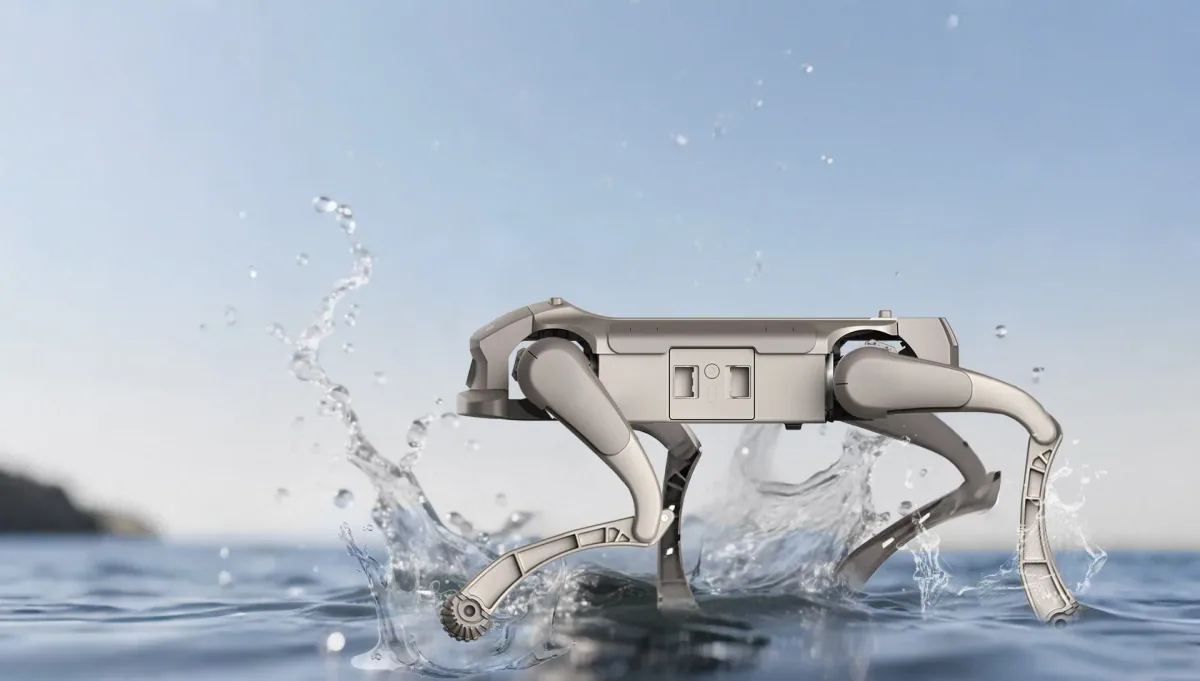
Robot dog on a construction site: what it is used for
On a construction site a robot dog has one job: to walk a route a person would otherwise walk with a camera, and to do it the same way every time. Progress photographs from the same points each day, a scan of a floor before the ceiling closes over the services, a look around the perimeter after the gates are locked. It carries the instrument, and it has legs because a site has no finished floor for wheels to roll on.
- The route changes every week, and that is the real difference from a plant.
- In a refinery or a substation the round stays the same for years. On a site, the stair that was open on Monday is behind formwork on Thursday, and a trench appears where the robot walked yesterday. So ask less about top speed and more about how a route is taught and how quickly it can be taught again. The D1 Max lists GNSS-RTK positioning and two 96-line LiDAR units among its equipment. The D1 Ultra lists a camera and an inertial sensor and neither of those. What turns those into a daily capture round on your site is set-up work, and it is repeated as the building grows.
- Ground and weather pick the model.
- The D1 Ultra is the small one: 16 kg, rated IP54 against dust and splashing water, good for a continuous step of 16 cm and published for 0 °C to 40 °C. That suits a structure with the envelope closed and the stairs in. The D1 Max is the site machine. It is rated IP67, works from -20 °C to 55 °C, takes a continuous step of 25 cm and a 45 degree slope, and switches between wheels for distance and legs for obstacles. AGIBOT's parameter sheet gives no minimum passage width for it, though its SDK development guide lists one, so measure doorways and gaps against that figure and its 480 mm body. Mud, rain, a winter morning and a ramp of compacted fill are D1 Max conditions. Walk the route and measure the tallest step and the steepest ramp before choosing, because both models publish those limits and a site rarely does.
- What it carries decides what you get back.
- The robot's own cameras are there for driving it. The record you want, whether that is panoramic photographs, a laser scan or thermal images, comes from an instrument mounted on its back. The D1 Ultra carries an effective 5 kg. The D1 Max carries 25 kg and supplies power to an attachment, up to 480 W. No survey scanner and no progress-tracking software is part of the catalogue, and no accuracy figure is published for the D1 Max's own LiDAR: choosing the instrument and getting its output into the tool your site team already uses is integration work.
- How much of the site one charge covers.
- The D1 Ultra runs 1–2 hours and about 6 km. The D1 Max publishes about 5 hours and 29 km unloaded, and about 3.5 hours and 18 km fully loaded, on batteries that can be swapped without shutting the machine down. Plan against the loaded figure, since a capture robot always carries something.
- People, and what is not published.
- A camera that walks a site every day films the workforce, so agree with the main contractor how long images are kept and who sees them before the first round, not after it. Agree too who escorts the robot while trades are working: the D1 Max weighs 41 kg, and a machine of that size on a live site belongs in the site's safety plan like any other plant. Neither model carries an ATEX certification, so an area classified for explosive atmospheres is outside this discussion.
Both models rent on request. The D1 Max Patrol, with a thermal camera for scheduled rounds, is rated IP55, not IP67. A site is a good place to rent before buying, because the question is whether a daily walk gives your team something they act on. Pick one route, one instrument and one person who will read the result each morning, and run it for long enough to see the building change.