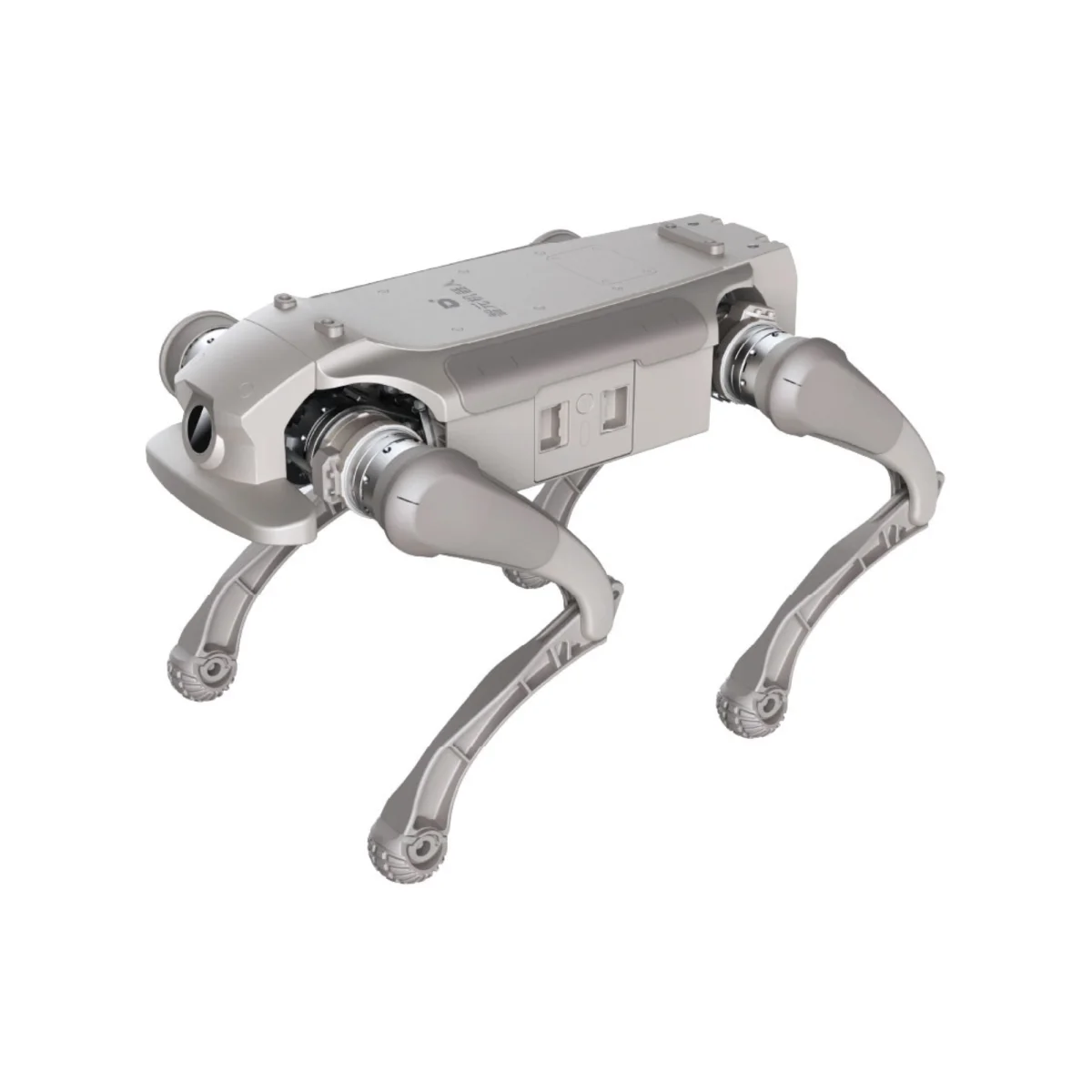
What it does
Photography and published figures from AGIBOT, the manufacturer of this model.
Wheel-legged mobility
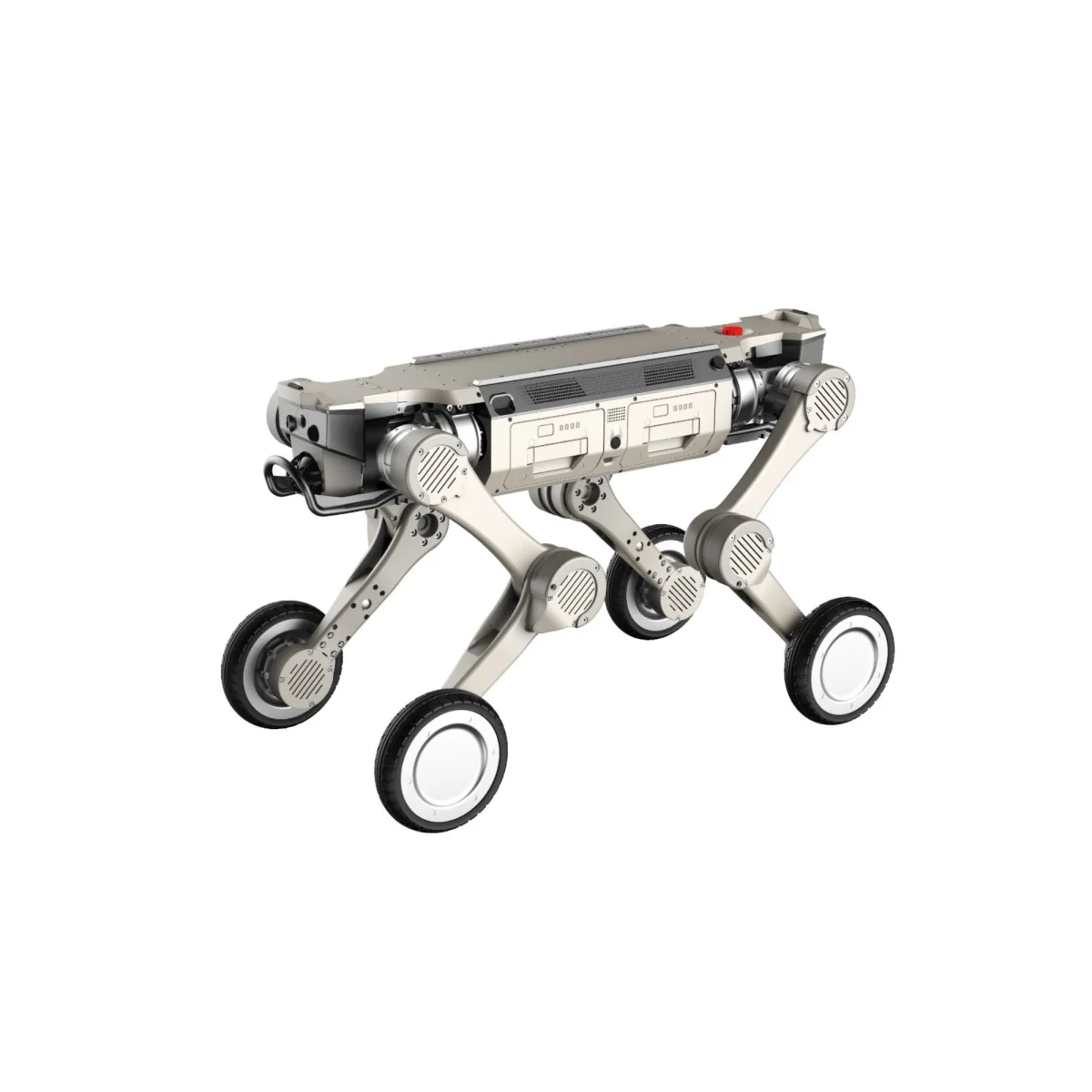
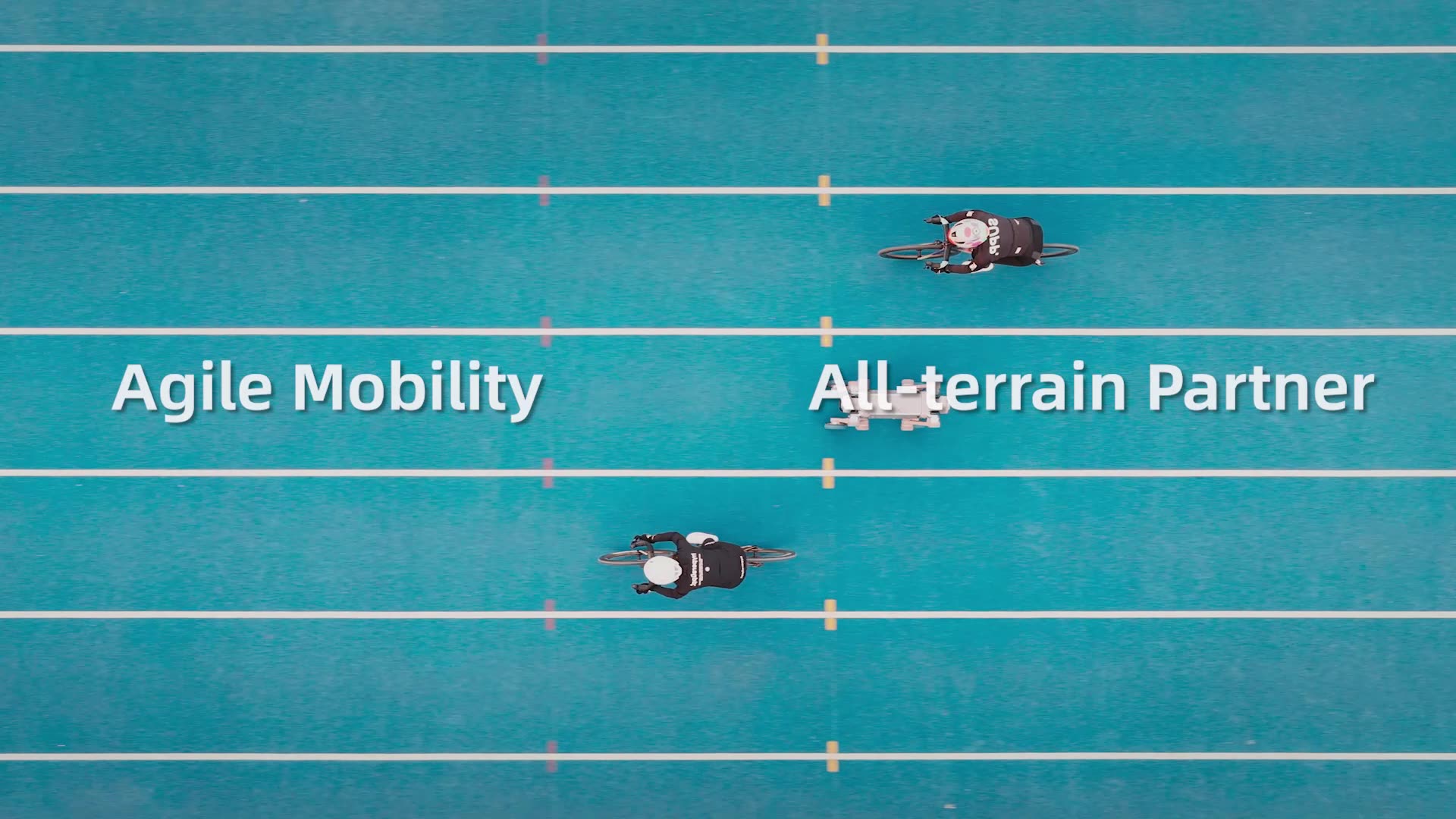
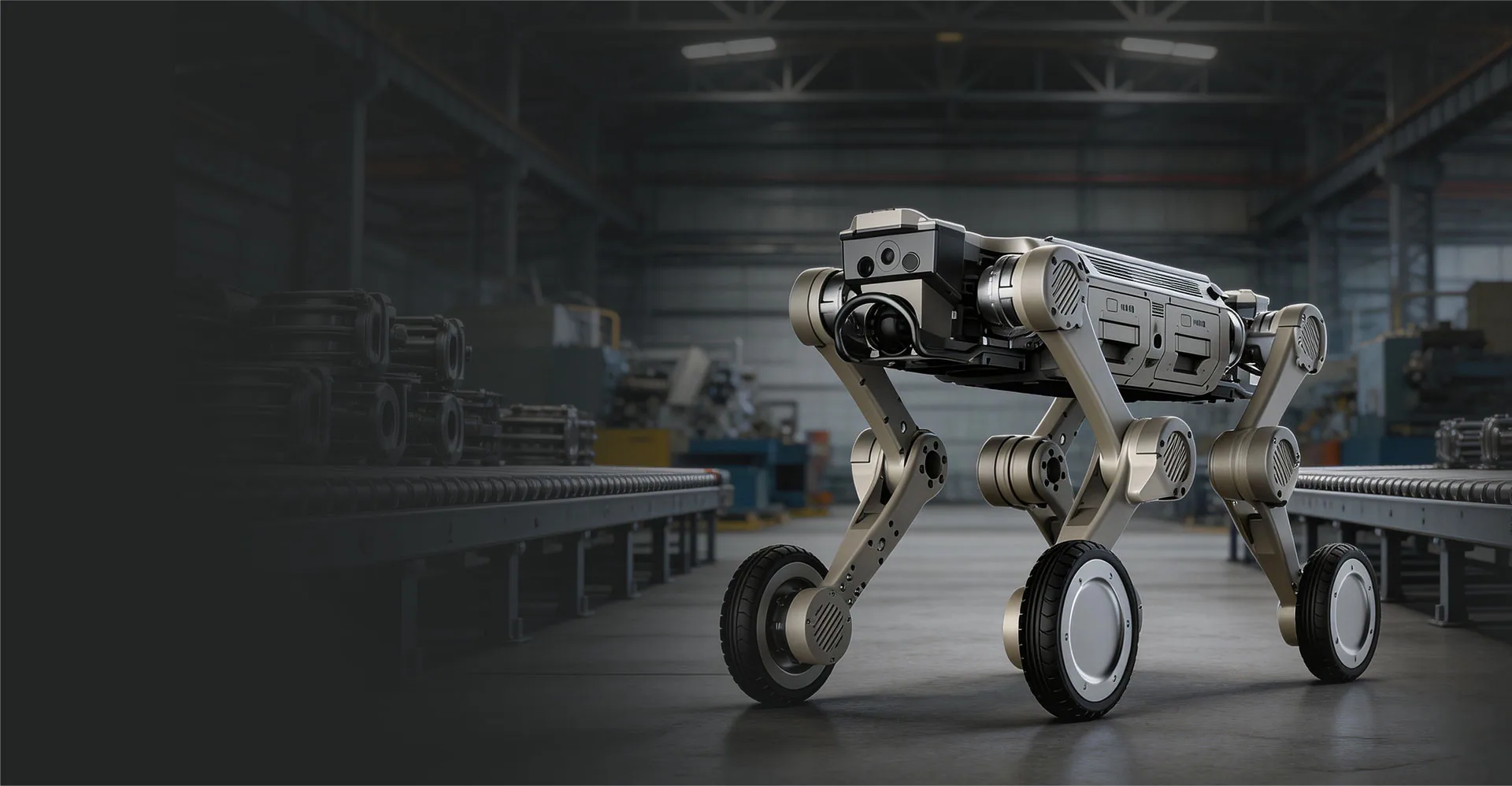
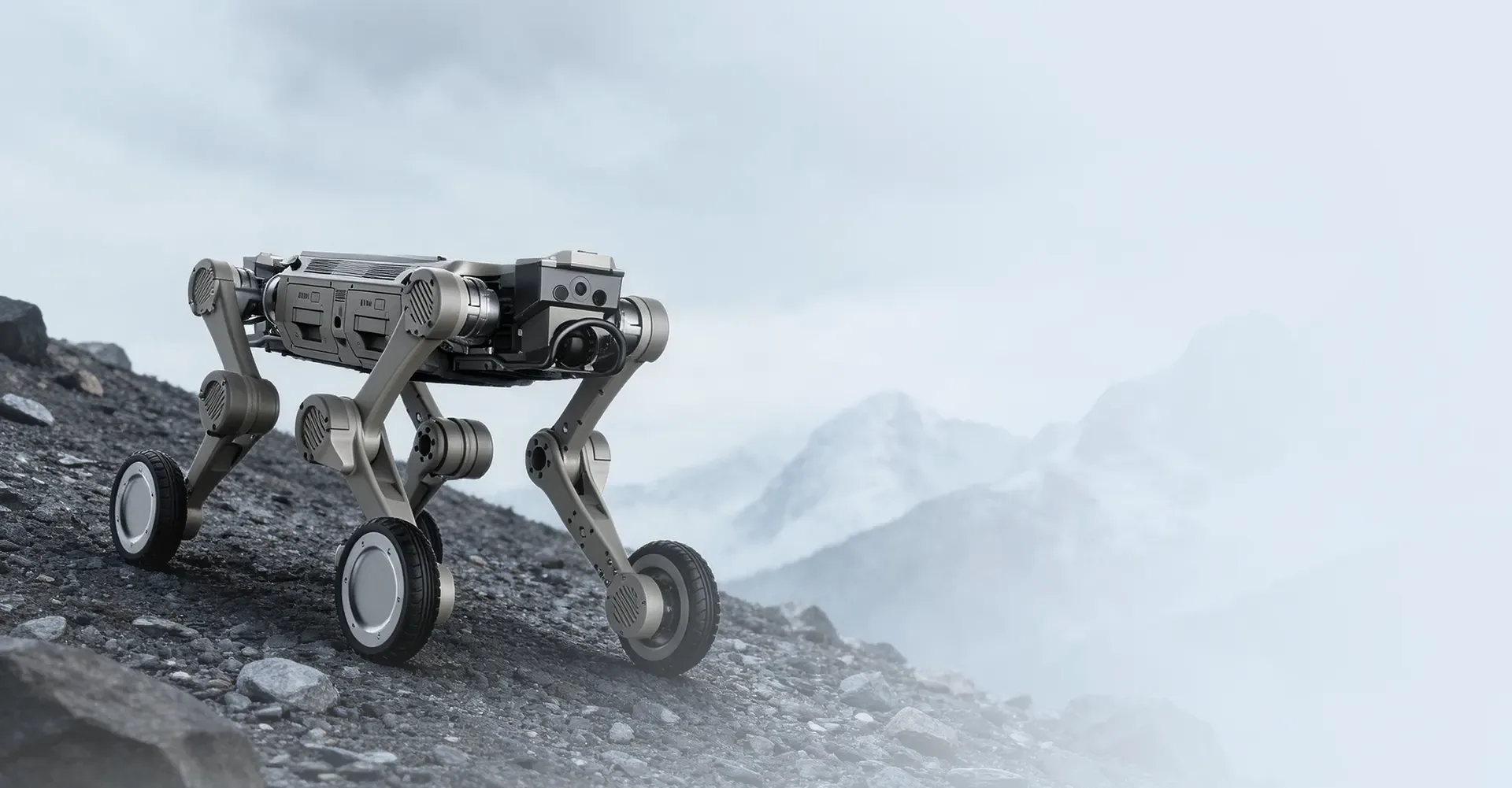
Switches between wheel mode for efficient distance and leg mode for obstacles, climbing 45 degrees and crossing 80 cm.
A full shift of range
Rated by AGIBOT at 29 km unloaded and 18 km fully loaded, on hot-swappable dual batteries that let one machine keep working while a pack is changed.
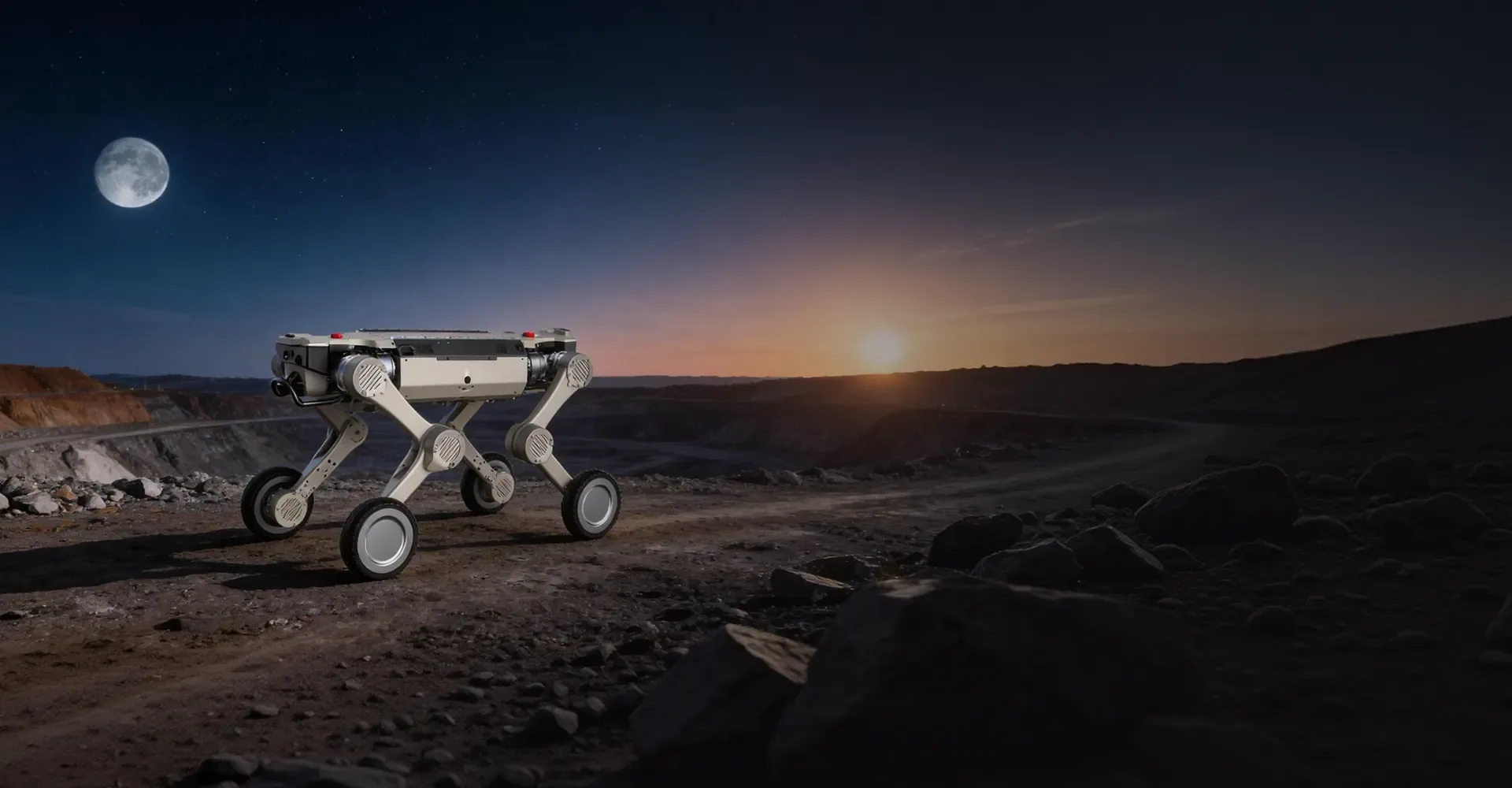
IP67 in all weather
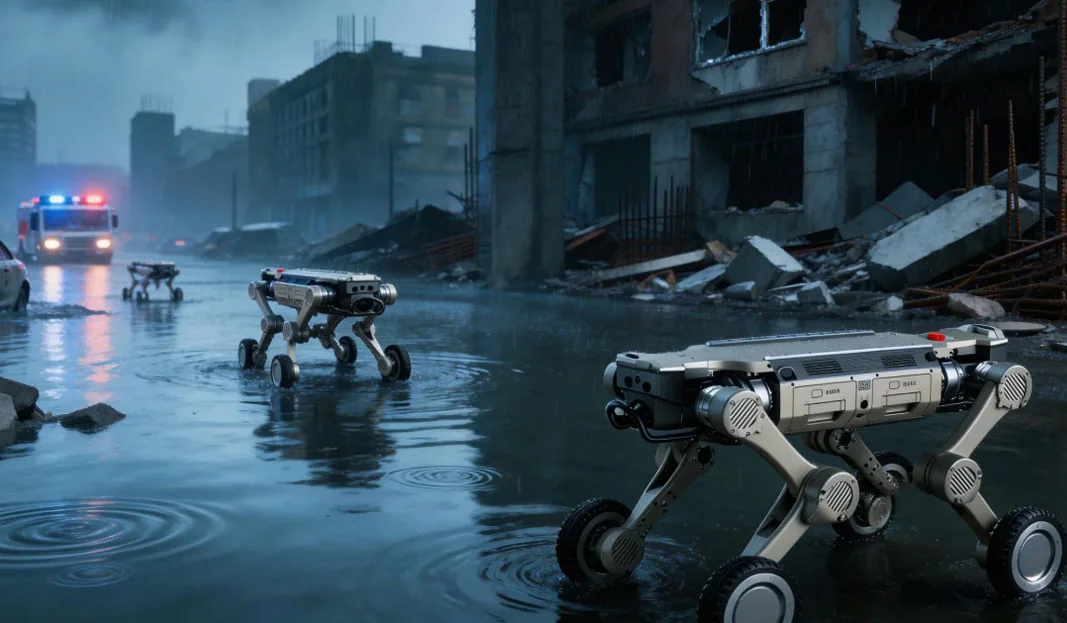
Rated IP67: dust-tight, and sealed against immersion to one metre for thirty minutes. That covers rain, puddles and standing water, outdoors or on an industrial site, through the seasons. Jet washing is a separate test that IP67 does not include.
Logistics and transport
A rated payload of 25 kg, with communication, power and control interfaces for task-specific attachments.
Search and rescue
Carries sensors into conditions that are unsafe to survey on foot, and over ground that wheels alone cannot cross.
Shown in motion
Silent excerpts from footage published by AGIBOT, the manufacturer of this model. Each one shows something a still photograph cannot.
Where wheels alone stop
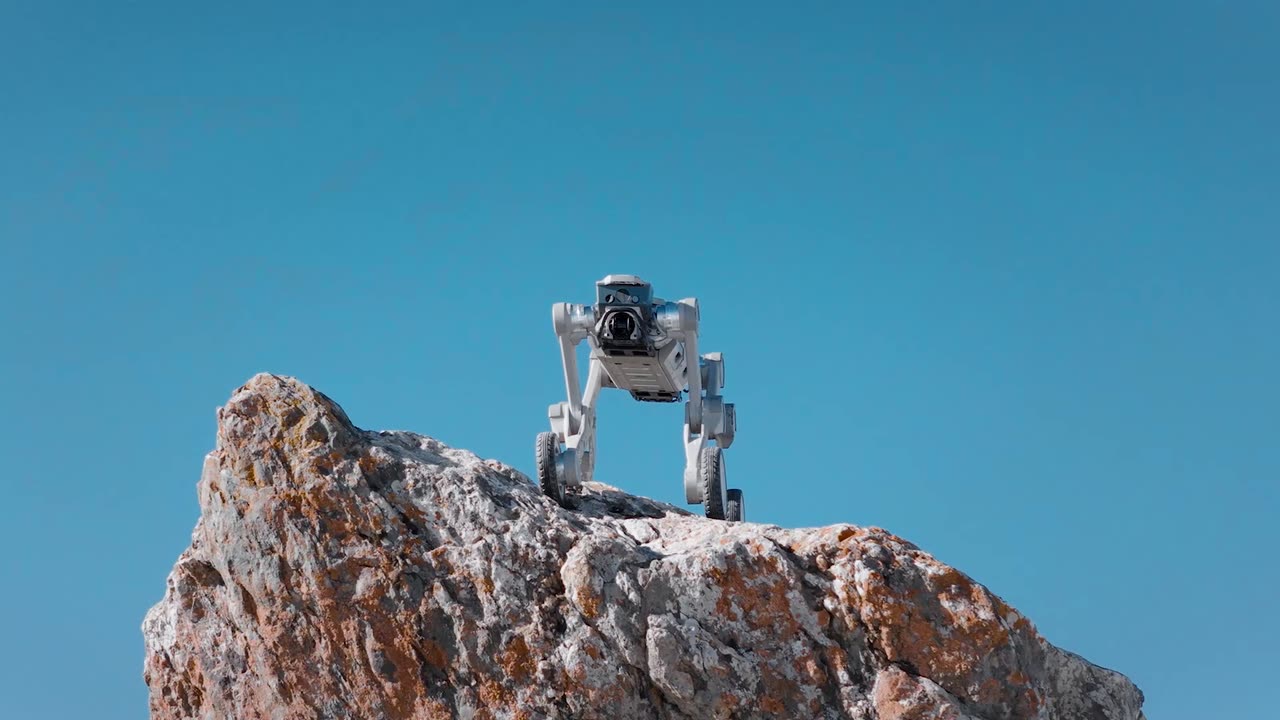
A rock outcrop first, then a narrow stone causeway over open water with nothing to either side. Wheels are what make distance cheap on made ground. This is the ground that explains why the legs are there as well.
Up on two wheels
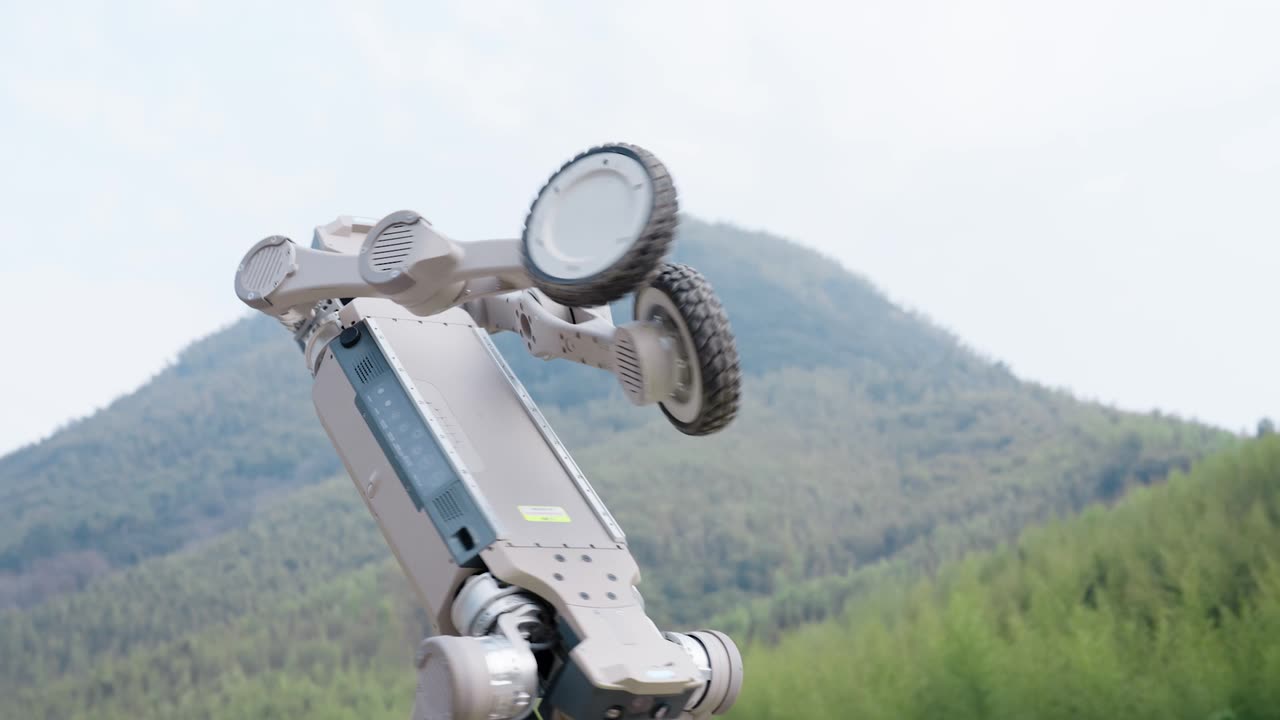
The machine rises onto two wheels and drives balanced there, first in a shed and then on open road. It is the clearest look at what the wheel-legged layout buys: the legs are not only for obstacles, they change the shape of the machine while it moves.
Software and SDK
- Licence
- no licence file
The repository ships an SDK but no licence file, which by default means all rights reserved. Treat it as unlicensed until AGIBOT confirms otherwise in writing. We will raise it with the manufacturer as part of your project.
The variants, and what changes
These trims share the base platform, so the useful comparison is not the full parameter table repeated for each one but the rows where each one says something different. Where a variant is a mirror-image build with an identical specification, there is nothing to tabulate and we say so instead of inventing a difference.
Where these models differ. Rows every model states identically are left out.| Technical specification | AGIBOT D1 Max | AGIBOT D1 MaxPro |
|---|
| Dimensions standing | 930 × 480 × 585 mm | 1270 × 520 × 730 mm |
|---|
| Dimensions lying | 930 × 630 × 200 mm | 1360 × 570 × 300 mm |
|---|
| Weight with battery | 41 kg | 68 kg |
|---|
| Battery module spec | 54 V, 2 × 504.9 Wh, hot-swap | 45 ± 1 Ah, 2081 Wh, quick-swap |
|---|
| Charging time | < 1.5 h | Approx. 4.5 h (10% to 90%) |
|---|
| Runtime | 5 ± 0.5 h unloaded / 3.5 ± 0.5 h fully loaded | 5.5 h unloaded / ≥ 2 h fully loaded (50 kg) |
|---|
| Range distance | 29 ± 1 km unloaded / 18 ± 1 km fully loaded | 21 ± 1 km unloaded / 11 ± 1 km fully loaded |
|---|
| Max speed | 6 m/s | 3 m/s |
|---|
| Step height continuous | 25 cm | 30 cm |
|---|
| Joint range body | -30° to 40° | -45° to 45° |
|---|
| Joint range thigh | -160° to 160° | -200° to 20° |
|---|
| Joint range shin | -160° to 160° | 30° to 160° |
|---|
| LiDAR spec | 2 × 96-line, 360° × 90°, 120 m diameter | 96-line, 360° × 90°, up to 120 m diameter, 1.5 cm accuracy |
|---|
| Cameras | 2 × FPV, 8 MP, DFOV 122° / HFOV 111° / VFOV 70° | 2 × wide-angle, 2 MP, DFOV 150° / HFOV 130° / VFOV 73° |
|---|
| Communication interfaces | Wi-Fi 5.0, Bluetooth 5.0 | Wi-Fi 6.0, Bluetooth 5.2 |
|---|
AGIBOT D1 MaxPro
The heavy-payload member of the D1 range, rated to carry 50 kg, and the one to specify when the round has to carry weight rather than a sensor. Published figures are 21 ± 1 km unloaded or 11 ± 1 km fully loaded, 5.5 h unloaded or 2 h or more under a 50 kg load, a 68 kg body rated IP67, and a 96-line LiDAR covering a diameter of up to 120 m at 1.5 cm accuracy. Sustained walking speed is up to 1.2 m/s against a 3 m/s maximum, which AGIBOT caps at 2 m/s in software on delivered units: plan a route on the sustained figure, because the maximum is a capability and the sustained figure is the schedule.