

Robotics advice before you buy
Advice on whether a humanoid or a robot dog belongs in your operation, and if so where and how, before anyone signs for hardware.
What we look at

Robotics use
Which tasks in your process are genuinely suited to a general-purpose platform, and which are not.

Declared interest
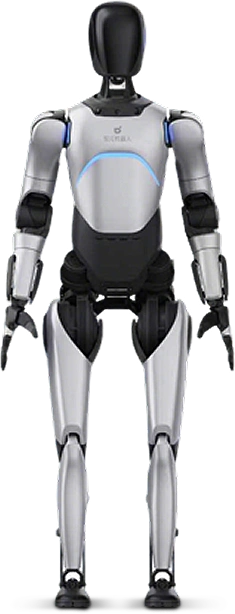
We sell AGIBOT hardware, and we say so up front. If the answer is a fixed arm, the report says a fixed arm.

Technical
Payload, reach, cycle time, floor conditions, network and safety, assessed against real figures.

Workflow
How the work actually flows today, and what changes around the robot once it arrives.
How an engagement runs
Discovery
A structured walk-through of the process, on site, with the people who run it.
- The tasks in scope, and the ones ruled out early with the reason
- Floor conditions, thresholds, lighting and network coverage
- Today's cycle time, and where the operator's hours actually go
Outcome: A written picture of the process everyone agrees on, before any platform is named.
Feasibility
A written assessment of what is achievable on platforms you can buy today.
- Payload, reach and tolerance checked against published figures, not estimates
- Achievable cycle time set against the one you run now
- The safety boundary the application needs, and who signs it off
Outcome: A plain yes, no or not yet, with the evidence each answer rests on.
Business case
Cost, cycle time and payback modelled against your own numbers, never a sector average.
- Purchase or rental, engineering, installation, training, spares and service
- Weighed against the labour and throughput figures you supply
- Every guess labelled, with how far the conclusion moves if it is wrong
Outcome: A figure you can take to a budget holder and defend.
Pilot design
A bounded proof of concept, when the assessment supports one.
- One real task, on your floor, not a staged demonstration
- Acceptance criteria and a measurement method agreed before anything is booked
Outcome: A test that can genuinely fail, which is the only kind worth running.
Vendor selection
A platform recommendation with the trade-offs stated plainly.
- The shortlist, and why each machine made it or missed
- Where our own AGIBOT hardware fits, and where it does not
- What you give up with each choice
Outcome: A decision you understand, including the case for buying nothing.
Roll-out plan
A staged deployment plan your team can execute and budget for.
- The phases in order, with what each one needs in place first
- Who owns each step, on your side and ours
Outcome: A path from pilot to production that does not depend on us being in the room.
What you receive
Consulting is easy to sell and hard to pin down, so this is what actually arrives.
- A written feasibility assessment
- , in your language, covering: the tasks examined and the ones ruled out early with the reason; the cycle time achievable on platforms you can buy today, against the cycle time you run now; payload, reach and tolerance checked against published figures rather than estimates; floor conditions, thresholds, lighting and network coverage where they affect the result; the safety boundary the application would need, and who has to sign it off; and the operator time the process gains or loses.
- A business case built on your numbers
- , not on a sector average. Purchase or rental, engineering effort, installation, training, spares and the service arrangement, set against the labour and throughput figures you supply. Where a number is a guess, it is labelled as a guess, and the model shows how far the conclusion moves when it is wrong.
- A pilot design
- , if the assessment supports one: a single task, on your floor, with acceptance criteria and a measurement method agreed before anything is booked. A proof of concept without criteria written in advance is a demonstration, and it always succeeds.
- And where the answer is no
- , a document that says no, with the conditions that would change it. That is the outcome for a real share of the processes we look at. It is a cheaper thing to buy than a robot that turns out to be the wrong tool, and it is the reason this service exists as a separate line rather than as a free pre-sales call.