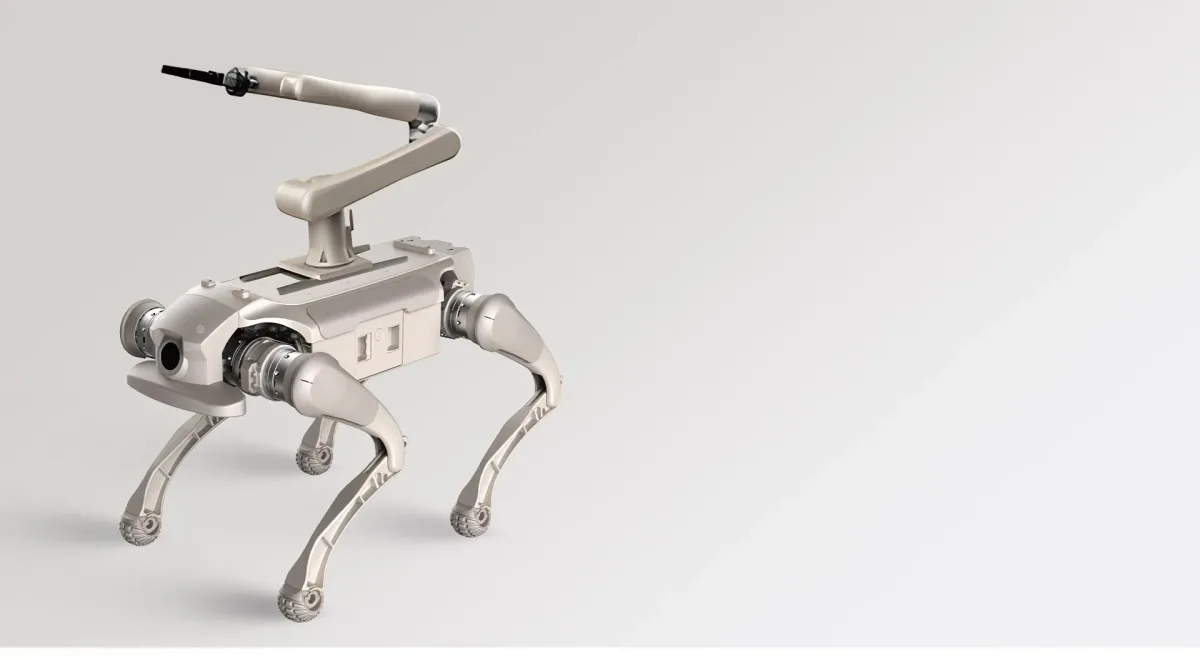

What a battery swap routine actually needs, model by model
A battery that needs changing mid-shift is not a fault, it is the normal cost of a platform light enough to walk. The real planning question is which pack, how many of them, and who on the floor is actually equipped to change it.
- The A3 swaps in ten seconds and barely interrupts the shift.
- AGIBOT publishes dual battery packs at 1,152 Wh combined, full-tab cells, and a ten-second hot-swap feeding a runtime of up to ten hours. That is fast enough to fit inside a normal break rather than needing one scheduled around it, and it is the number to plan a fleet's shift pattern against if the A3 is doing the work.
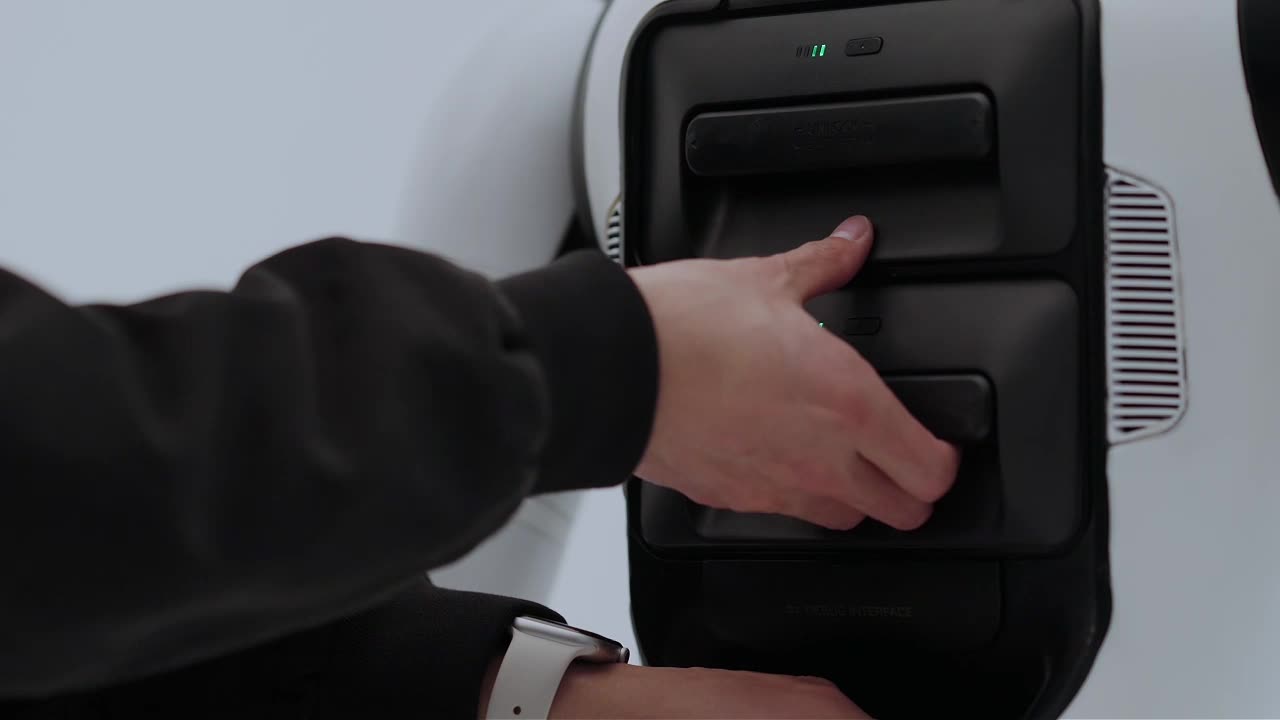
The A3's battery bay, releasing and reseating a pack in ten seconds, without tools: the swap the platform's ten-hour runtime figure depends on.
- The G2 needs a pair, not a spare.
- Its own listing is explicit that single-battery operation is not supported, so the G2 always runs on two packs and a spare order is always two SKUs, a left pack and a right, each sold with its own shell. Together they hold 1,652 Wh for roughly four hours of runtime, the swap method AGIBOT publishes is tool-free, and a depleted pair recharges in under two hours. Order one side and the platform still will not run on it alone.
- The A2 Ultra carries one pack instead of two, and trades runtime for a simpler routine.
- A single 14.4 Ah pack is swappable with fast charging and rated at about 3 hours standing and 1.5 hours or more walking, so it changes more often than the A3 or the G2, but the routine only ever involves one part. The clearest evidence for how that holds up over a long run is the platform's own Guinness World Record: 106 km walked over four days, on 15 battery swaps and a single rest of about 17 hours. That is not a lab figure, it is the same swap repeated fifteen times without the record ending.
- Tool-free is stated for one of the three, not assumed for all three.
- AGIBOT's own listing names the G2's swap method as tool-free explicitly; the A3's published figures describe its swap as hot, meaning the platform keeps running, and the A2 Ultra's call its pack swappable, which is not the same claim. Neither says whether a tool is needed. The distinction matters for who gets sent to do it: an untrained operator reaching for a fast pack change on the wrong platform is the failure mode a five-minute confirmation call avoids.
- Among AGIBOT's quadrupeds, only the D1 Max, and the D1 Max Patrol built on it, carries a hot-swap claim the way the A3 and the G2 do.
- The D1 Max parameter sheet lists two 54 V packs of 504.9 Wh each with hot-swap support, charging in under 1.5 hours for about five hours unloaded. The D1 Max Patrol, the same machine with AGIBOT's patrol kit fitted, lists hot-swap too, but not those times: AGIBOT's draft specification gives a 4-hour charge from 20% to 90% and 3 hours of running at 1 m/s in the laboratory. A D1 Ultra battery module is 4.6 Ah at 43.2 V, charges in about an hour and returns the platform to one to two hours of runtime. The D1 EDU and D1 Pro share a spare pack with no separate published rating of its own, sold as the second pack that keeps a teaching or research unit running between sessions rather than as a mid-task swap. For those, nothing published reads as a swap made while the platform keeps working, and it is worth confirming directly for a patrol route that needs more than one charge in a shift, rather than assuming the wording for the A3 and the G2 carries across.
Whichever platform is doing the shift, the swap routine is a layout and a staffing decision before it is a purchasing one: where the spare pack sits charged, who is trained and equipped to change it, and how long the platform actually runs before the question is asked for real. Settle that before the first pack runs down on the floor, not after.