
When fitting a gripper makes you the machine's manufacturer
A purchase order buys a machine. It does not settle what you become once it is on your floor, and Regulation (EU) 2023/1230 is written around roles rather than who paid. Who the importer is depends on where the machine crossed into the Union under Regulation (EU) 2019/1020, and that is covered separately here. This is the other half: what happens when you add something to the robot, or connect it to something else, and the result is no longer the machine its manufacturer placed on the market.
- Three roles, and only one of them is simply the customer.
- The first is the user: you buy a complete machine, operate it inside the intended use its instructions describe, and the manufacturer's file stands. The second is the assembler: you combine the robot with other machinery so the pieces work as one whole: a cell, a guard, a conveyor, a fixture, a gripper you chose yourself. That assembly is a new machine and whoever put it together is its manufacturer. The third is the modifier. You change the machine itself in a way its manufacturer did not foresee, which makes you the manufacturer of the modified machine whatever badge is on the casing. All three can sit in one building, and a project crosses between them without anyone noticing.
- What actually flips you across.
- The Regulation's term is substantial modification, and its test has two halves worth holding separately. Was the change foreseen or planned by the manufacturer, and does it affect safety by creating a new hazard or increasing an existing risk. Both are questions of fact, not of paperwork. Fitting an accessory the manufacturer lists, as the instructions describe, is foreseen. One of your own design, or running the machine past a published limit, is not. Whichever way the answer falls, what follows is the same list: a risk assessment for what you have actually built, a technical file, instructions in the language of the country it is used in, an EU declaration of conformity and the CE marking that goes with it.
- Where the published figures decide it.
- Intended use is not an abstraction: it is what the manufacturer wrote down, and most of it lives in the spec table. The G2 publishes 5 kg of payload per arm; the X2 Ultra 3 kg at most, 1 kg or less across the full range, and a reach of 558 mm, all without an end effector; the A2 Ultra approximately 2 kg per arm. A gripper that keeps the load inside those figures, on a machine whose instructions cover fitting one, is a different event from one that takes the load past them. Where the catalogue publishes no figure, the honest reading is that you have no published limit to point at, not that no limit exists. Put that to the manufacturer before a bracket is machined.
- What engineering work does and does not take off your hands.
- Robotoplus writes application software, perception and navigation, runs a proof of concept on your own process, and commissions the machine at delivery under a 12 month warranty. Engineering time beyond that is 825 EUR per day. None of it transfers the manufacturer's role: a supplier writing code to your specification did not decide what the assembly would be, and no invoice moves that decision. What can be settled, in writing, before work starts: who assembles, who writes the risk assessment for the assembly, who compiles the file, and whose name goes on the declaration. A proof of concept is the cheap moment for that conversation, while the cell is still a drawing.
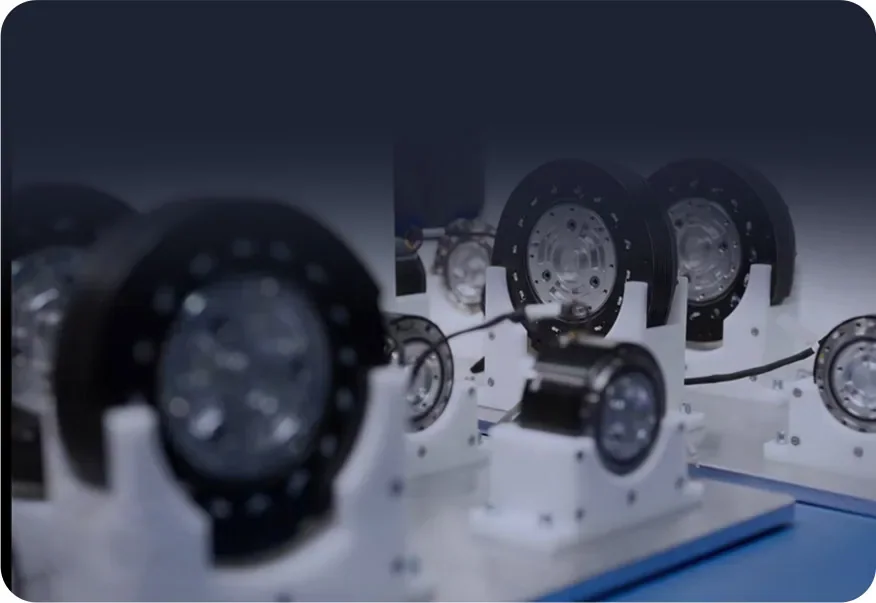
AGIBOT's own image of A2 Ultra joint actuator modules on a bench. It is worth looking at because the manufacturer's file covers these parts as the manufacturer assembled them, and the moment a bracket of your own design carries one, the thing in front of you is not what that file describes. Nothing in the picture tells you where the line falls, which is why the line lives in the instructions rather than in the hardware.
The Regulation becomes mandatory on 20 January 2027, replacing Directive 2006/42/EC, so a cell being drawn now will be assembled under it. None of this is legal advice, and the text governs rather than any summary of it. The question to carry into the design review is short: after this change, is the machine on your floor still the one the manufacturer placed on the market. If the answer is no, the file is yours, and knowing that at the drawing stage costs a conversation rather than a rebuild.