Can robot dogs climb stairs? Step height by D1 model
A spec sheet gives you one number for how a quadruped handles a step: continuous step height. It is worth being precise about what it means before it decides a route for you. It is not the tallest obstacle the machine can scramble over once. It is the height the platform is rated to climb and descend repeatedly, in a gait, without a person watching each attempt.
That distinction is the whole post. A kerb a robot can heave itself over as a one-off party trick tells you nothing about whether it will still do that at the two-hundredth repetition on a route it walks all day. Continuous is the word doing the work.
- Three numbers, three routes, and the Patrol's own.
- Across the D1 range, continuous step height runs from 16 cm on the D1 Ultra to 25 cm on the D1 Max and 30 cm on the D1 MaxPro. That is not one figure with a variant attached to it, it is three different answers to "which kerbs and stair risers can this walk over as a matter of routine". A typical city kerb is low enough for the D1 Ultra to clear with margin. A standard interior stair riser is taller, closer to where the job wants the D1 Max or above. Loading-dock lips and heavier plant kerbs are taller again, which is where the D1 MaxPro's higher continuous rating earns its place. The D1 Max Patrol, the D1 Max with its patrol kit fitted, has a figure of its own in AGIBOT's draft specification: 20 cm of stair height in autonomous mode, which the document does not call continuous. Plan an autonomous Patrol round against 20 cm, not the bare D1 Max's 25 cm.
- Route planning starts with the worst step, not the average one.
- A site walk that is flat for 95 percent of its length and has one tall threshold at a doorway is, for planning purposes, defined by that threshold. Averaging the terrain hides the feature that actually matters: the tallest step the machine has to cross without a person lifting it over.
- What the catalogue does not publish, and why that matters.
- Continuous step height is not the same figure as maximum slope, maximum single obstacle, or stair-descent speed, and none of those substitute for each other. Where the sheet gives you the climbing figure and says nothing about descent behaviour on the same feature, that is a real gap, not an oversight to paper over: descending a step changes the load path and the contact sequence, and a platform can be conservative about one direction and not the other. Ask the specific question rather than assuming the ascent number covers it.
- Weight class is not incidental to the figure.
- Those three D1 variants are not the same chassis with a firmware limit dialled up. A heavier, taller platform generally needs to lift its centre of mass further and manage more inertia through the same joint travel, so a higher continuous step height on the MaxPro reflects a different mechanical envelope, not just a more generous number on the same machine. That is also why the figure is worth checking per SKU rather than per product line: two machines in the same family can answer the same question differently.
- What to measure before you order.
- Walk the actual route with a tape measure, not a floor plan. Note every threshold, kerb, drainage grate and stair nosing above roughly 10 cm, and check the tallest one against the continuous rating of the specific variant you are pricing, not the range as a whole. If the worst feature sits above what a variant is rated for continuously, either the route needs a ramp or ledge treatment, or the spec needs to move up a class. That is a five-minute site check that avoids a machine arriving unable to do the one job it was bought for.
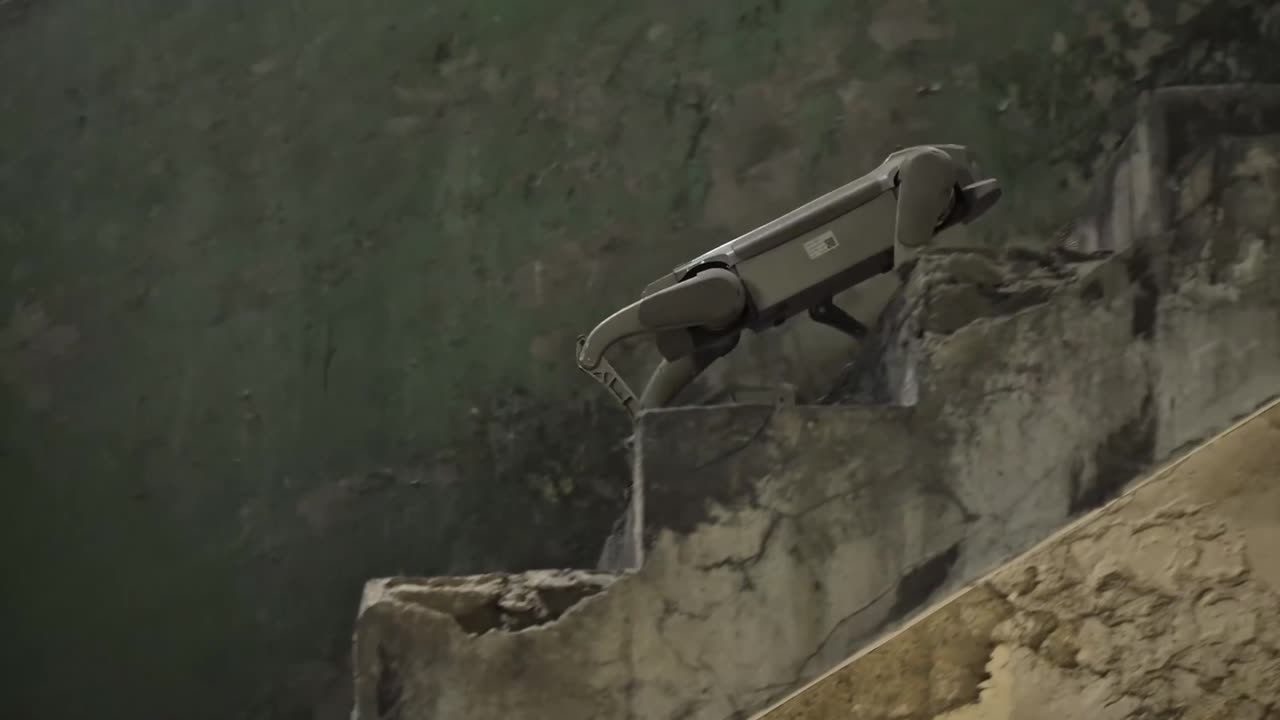
Manufacturer footage of an AGIBOT D1 Ultra on a flight of stairs.
We are happy to help match a specific route to these ratings before anything is ordered.