Robot dog balance: what the D1 Ultra's figures show
A quadruped recovering its footing after a stumble looks like the same problem at every weight class, and the D1 Ultra's own figures are the reason it is not.
- A 16 kg platform has less momentum to arrest, and less margin to do it in.
- The D1 Ultra carries a peak joint torque of 48 N·m at each leg joint, rated for a maximum incline of 30 degrees in standard operation and up to 40 degrees at the extreme. Those numbers describe a platform built to be light and quick rather than to muscle through instability, which changes what recovering from a stumble actually means: less mass to catch, but also less torque reserve to catch it with, and a narrower margin before the incline rating itself is the limit rather than the ground.
- Stability margin is not the same question as maximum incline.
- The 30-to-40-degree figure describes what surface angle the platform can walk on deliberately; it says nothing on its own about an unplanned tilt mid-stride, which is a faster, less controlled event than a slope the platform chose to climb. A platform rated to walk a 30-degree incline is not automatically rated to absorb a 30-degree stumble at speed, and reading the incline figure as a stability guarantee is the mistake worth avoiding.
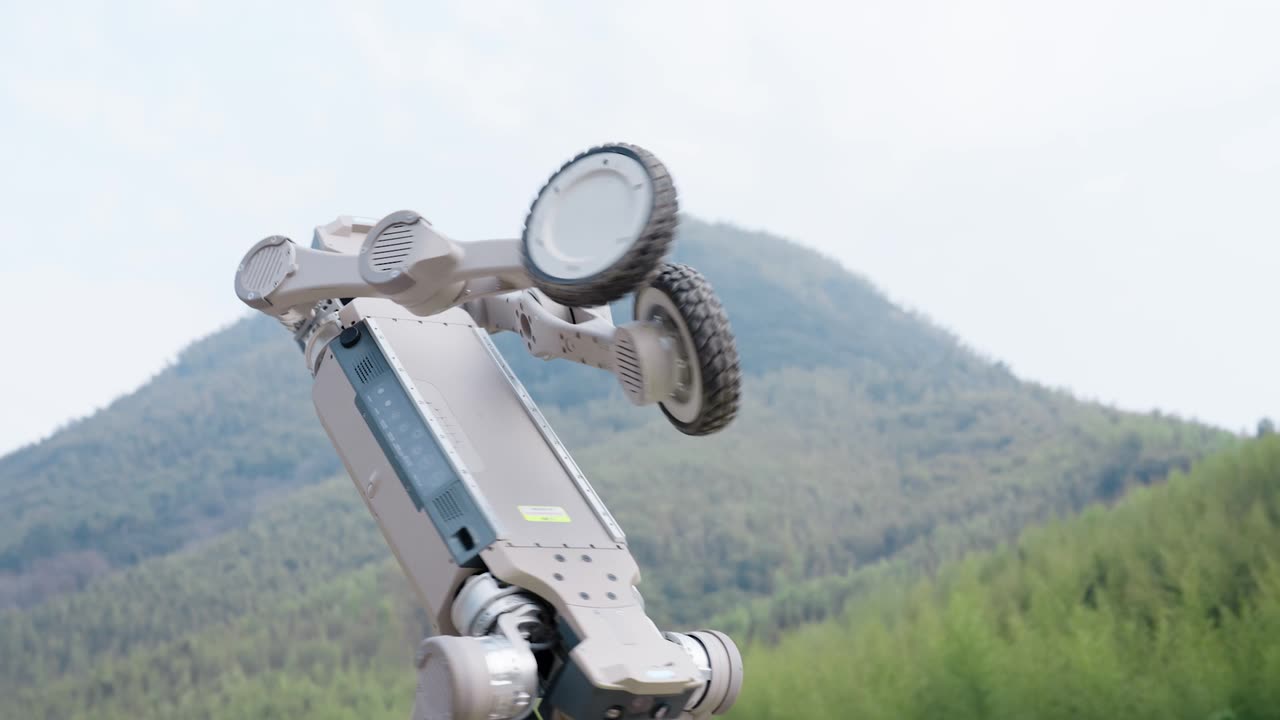
A D1 Max, not the D1 Ultra the figures above describe, holds its footing under disturbance: the same control problem this post is about, one weight class up.
- Lighter is not automatically more stable, and it is not automatically less stable either.
- A 16 kg platform accelerates and decelerates faster than a heavier one for the same actuator effort, which cuts both ways: recovery can happen faster, and instability can also develop faster, before a control loop has time to respond. The peak torque figure is what bounds how hard the platform can push back against a stumble in progress, and 48 N·m per joint is the number that actually answers how much correction is available, not the incline rating and not the weight alone.
None of these three figures answers the stability question by itself. Read together, they describe a platform built for quick, light movement over uneven ground rather than for muscling through instability the way a heavier quadruped might, and that is a design choice worth understanding before assuming one weight class's stability behaviour applies to another.