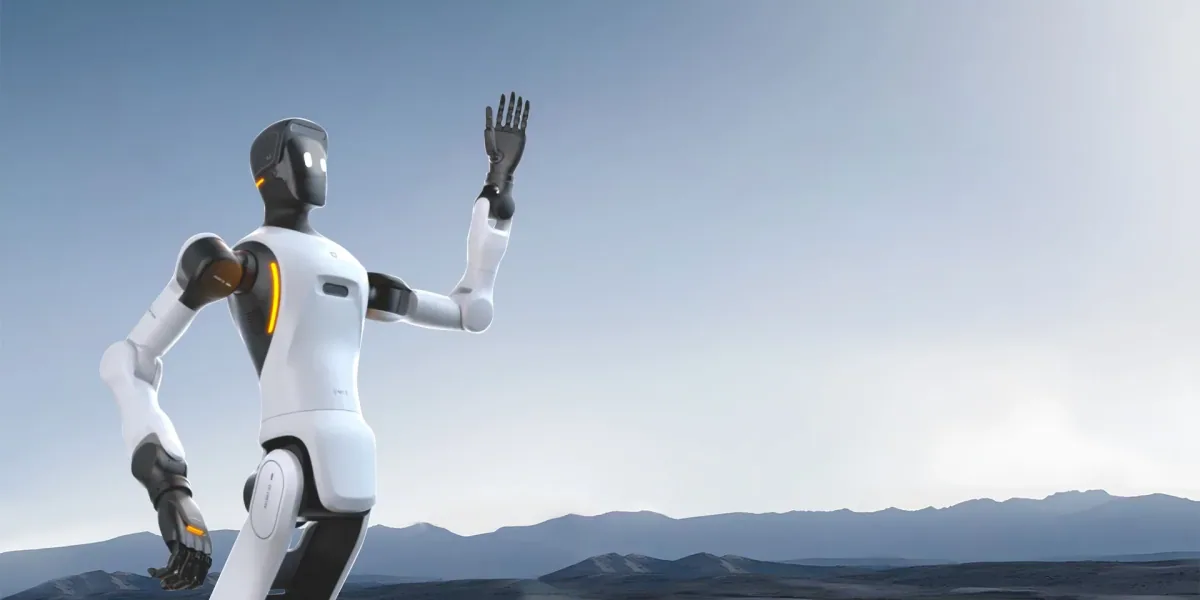
What a robot can be trusted with at an awards ceremony
An awards evening is the opposite of a party, where the robot fills the gaps and nobody minds. There is a running order, a stage manager counting cues into a headset, and a category announcement that happens once, in front of the person it is about, with a photographer already crouched at the front of the stage. Every useful question about a robot at a gala falls out of that single difference.
- The rehearsal is the deliverable.
- It means a run-through in the room, on the floor the machine will actually use, with the lighting state that will be on and the sound that will be playing under it. That is the only way to learn whether a riser and a carpeted ballroom feel the same underfoot, whether the lighting change lands where the machine stands, and how long the sequence really takes against the cue sheet. Book that slot at the same time as the machine, because it is the first thing sacrificed when a venue runs late and the one thing everything else depends on.
- What it can be trusted with when there is no second take.
- The list is short on purpose: holding a mark, taking a cue and walking a rehearsed line. Carrying the award needs a figure and a question. Weigh the trophy against 5 kg per arm for the G2 and approximately 2 kg for the A2 Ultra, and ask which hand or gripper the unit carries. An award in solid glass or cast metal can sit between those two numbers, and it is the sort of thing nobody checks until the crate arrives from the engraver two days before.
- On a stage shared with a winner, distance decides before speed does.
- The G2 publishes 1.5 m/s and the A2 Ultra a maximum of 1.2 m/s, and neither is the pace of a cue, so ask what pace the unit is set to and rehearse at it. The larger question is how close the winner stands. AGIBOT's EU manual assessed the G2's safety functions for an area that nobody enters while it is powered, and the G2 is hired for events with a fenced area around it, which the organiser arranges with the venue, so on a gala stage it belongs behind a barrier and not beside the winner. No humanoid platform here publishes a stopping distance, so give the winner more room than feels necessary. The G2's manual asks for slopes of 5% or less, so a riser means a long, shallow ramp; AGIBOT's product page gives the A2 Ultra ramps of up to 10 degrees, a slope and not a step. If the sequence asks the A2 Ultra both to walk with somebody and to carry their award, that tension is the decision. Unless the rehearsal shows the unit doing both steadily, a person carries the award and the machine holds its mark.
- Plan as if it will not improvise, so anything unrehearsed is not in the show.
- No ad lib to a host who is running long, no reaction to a winner who leaves the table on the wrong side, no filling because the video desk lost a playback. The failure mode is worth naming precisely, because it does not look like a breakdown: a cue is missed, the machine finishes the move it was given, and it is now standing exactly where the next segment needs empty floor. So rehearse the abort with the same care as the sequence. One position the machine returns to and holds on a single instruction, and one named person whose only job at that moment is to give it.
Then send the stage manager a run of show with the robot's cues written into it in the same form as everybody else's: the cue that starts it, the cue that stops it, and where it stands in between. Its exit belongs there too, since the A2 Ultra publishes approximately 3 h standing and 1.5 h or more walking, and on a long evening leaving the room is a cue like any other.