

Can a robot actually dance at your event: what ships and what is engineering
"Can it dance" is usually the first question anyone asks about a humanoid at an event, and it is a fair one. The honest answer is that dancing is a shipped capability, not a stunt someone built for a demo, but the gap between a preset routine and a working act on your stage is entirely engineering work.
- What actually ships.
- AGIBOT publishes over 20 preset movements for the X2, covering gait, dance routines and martial arts. That is a real, documented figure, not a marketing round number: the platform comes with a movement library that includes walking gaits, choreographed dance sequences and martial arts forms, ready to trigger. If your event needs "the robot does a dance move," that part exists off the shelf.
- What that number does not mean.
- Twenty-something preset movements is a library, not a show. It says nothing about whether those routines can be synced to your music, triggered on your cue, sequenced into a five-minute set, or repeated reliably in front of a crowd that is closer to the machine than a factory floor would ever allow. None of that is published anywhere, because it is not a catalogue figure: it is integration work specific to your event, your space and your run of show.
- Gait, dance and martial arts are one movement set, not three products.
- The same underlying control stack that lets the machine walk is what lets it hold a dance pose or throw a martial arts strike without falling over. That matters for a buyer because it means the movements are not separate add-ons you purchase individually. It also means anything that affects walking stability, an uneven stage, a raised platform, a slippery floor, affects the dance routines the same way, since they draw on the same balance and control system.
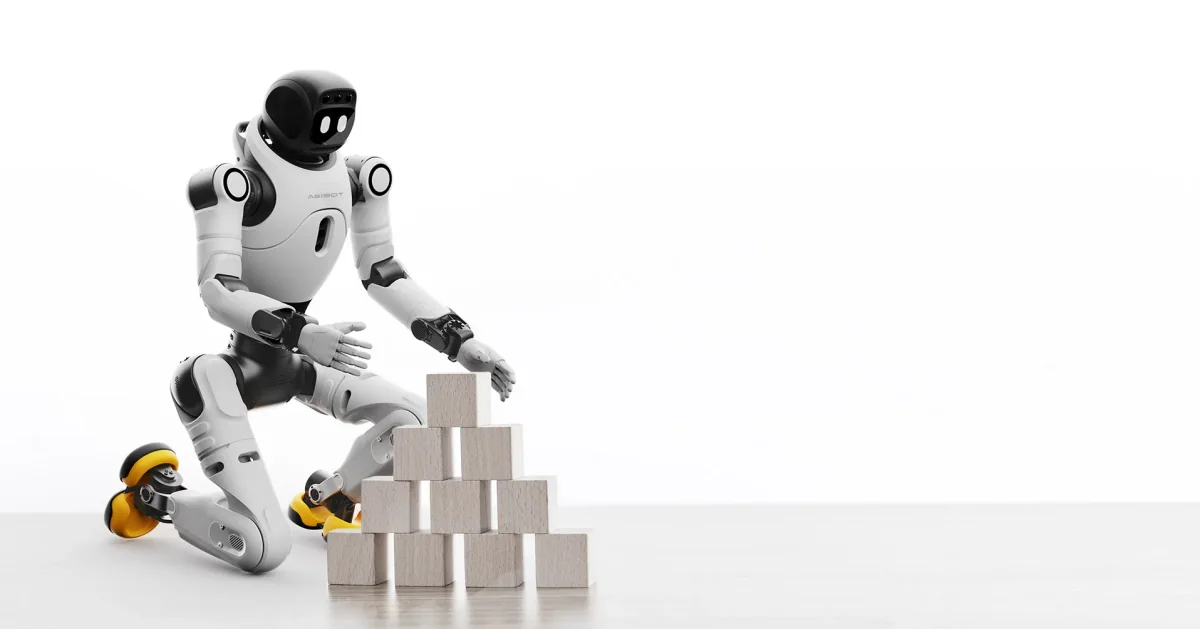
The manufacturer's own photograph of the X2 holding a low kneeling pose. The balance system doing that is the one that walks, which is the point of the paragraph above: a pose is not a feature bought separately. A studio floor is also not a stage, and nothing in this picture tells you how the machine behaves on one.
- Where the engineering actually sits.
- Getting from "the robot has preset dance routines" to "the robot performed at our launch" is the same category of work as any other deployment: defining the working area, agreeing how the routine starts and stops, and having someone on site who can intervene if a routine needs to be cut short mid-performance. None of that is a setting you flip. It is planning done before the event, the same way a proof of concept is planning done before a production line.
- What we cannot tell you.
- The catalogue does not publish how long a dance sequence runs, how much floor space a routine needs, or how the movement set behaves on an uneven surface, and we are not going to invent numbers to fill that gap. If your event has a fixed stage size or a hard timing requirement, that has to be tested on the actual unit, not estimated from a spec sheet.
If you are looking at a robot for an event, the useful next step is not "can it dance," which the movement library already answers. It is walking through your stage, your run of show and your cue system against what the platform actually ships, before anything is booked.