


AGIBOT A2 Guinness World Record: 106 km in four days
Endurance records are not just publicity. Walking that far stresses exactly the things that matter in production: thermal management, joint wear, battery handling and the reliability of the control stack.
Worth stating plainly, because the number gets quoted carelessly: the run was not continuous. It took four days, 15 battery swaps and one rest of about 17 hours. Guinness ratified it as the longest journey walked, not as the longest walk without stopping.
That makes it more useful to a buyer, not less. A platform that covers 106 km on a swap routine rather than a repair is a platform that can hold up to a shift pattern, and designing the swap into the process is the same work a real deployment needs anyway.
- Fifteen swaps is the number to look at.
- Not the kilometres. It means the machine was stopped, opened, changed and restarted fifteen times without the run being abandoned, which is a statement about the battery interface and about how quickly a person can be trained to do it. On a production floor that is the difference between a machine that covers a shift and a machine that needs a second machine.
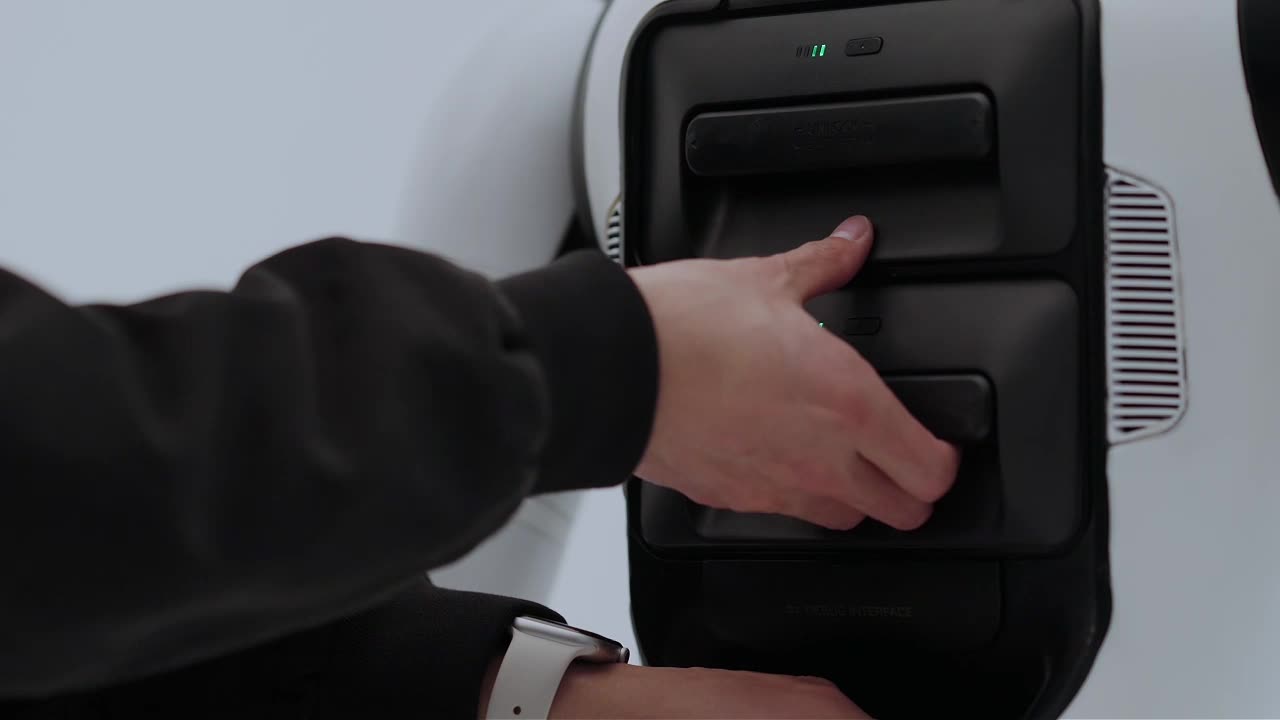
A human hand releases a battery module from the bay in the machine's back, draws it out and puts it back, with no tools. This is the A3 rather than the A2 that set the record: the footage is AGIBOT's and it was shot with an A3. Watch the bay itself, because that is the battery interface the fifteen swaps are a statement about, and not the model.
- What the published runtimes mean for your shift.
- Across the range the figures run from roughly an hour and a half of walking to ten hours with quick-change packs. If your shift is eight hours and the platform publishes three, you are not buying a robot, you are buying a robot plus a swap routine plus somewhere to keep charged packs plus the floor space that takes. That is a layout decision and it is cheaper to make before the cell is designed than after.
- What a record does not tell you.
- Nothing about your task. It is a walking test on a route somebody chose, and it says nothing about grip reliability on your parts, cycle time in your cell, or how the machine behaves when a pallet is 30 cm from where it expected one. Those are answered by running one task on your own floor and measuring it, which is what a proof of concept is for.
- And what it does tell you.
- That the mechanical and thermal design survives four days of continuous duty cycling, which is a real result and one most platforms in this category have not published a comparable figure for. Treat it as evidence about the hardware, not as a performance specification.
We are happy to talk through what the record run means in practical terms for a deployment, including what the swap routine would look like on your layout.