AGIBOT G2: wheeled humanoid specs and uses
A wheeled base is usually the platform that gives up reach for stability; the G2 is built to give up neither, and its published height range is the number that shows how.
- 1225 to 1795 mm is a taller range than it looks on a spec sheet, because it is the whole platform adjusting, not just an arm.
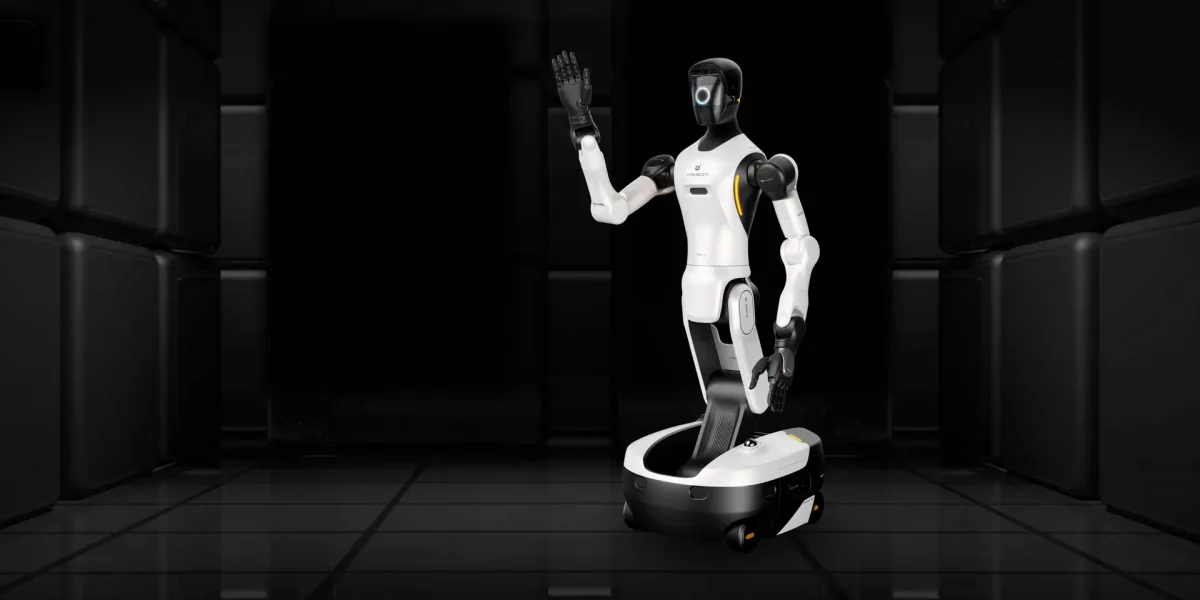
- AGIBOT states the G2 at that range on a fixed 640 x 760 mm footprint, so the same base that reaches a low shelf at 1,225 mm extends to 1,795 mm, close to 180 cm, for a high one, without walking closer or further away first. A wheeled base that never has to solve balance is what makes that range usable rather than a party trick: nothing about extending the column threatens the platform's footing the way it would on a bipedal frame.
- The trade for that stability is the floor itself: a wheeled base needs a flat, continuous surface and cannot manage a step, the ordinary cost of choosing wheels over legs.
- That is not a G2-specific limitation, it is the reason a wheeled platform exists as a separate category from a bipedal one at all, and it is worth weighing against the height range before assuming variable reach settles a floor's platform choice on its own.
- Two separate compute figures are published for the G2, and they answer different questions.
- An NVIDIA Jetson T5000 rated at 2,070 TFLOPS (FP4) is named as the platform's AI compute power; a separate HUIXI R1 chip rated at 500 TOPS (INT8) is named as its compute platform for real-time control. Quoting only the larger number treats the G2 as a single-chip machine it is not, and a buyer comparing "TFLOPS" across platforms without checking which workload each chip actually runs is comparing two different kinds of number.
- 26 degrees of freedom, 7 of them per arm and force-controlled, is what the height range is actually for.
- A platform that can only change height is a lift; one with force-controlled arms at the end of that reach can place a part or make contact at a height a fixed-height platform would need a stand to reach, and the G2's own sensor suite, with an RGB-D camera on each wrist beside the one in its head, is built for exactly that kind of close work rather than for navigating rough terrain.
- The battery answers a shift-length question the height range does not.
- A combined 1,652 Wh across dual hot-swap packs gives roughly four hours of runtime, charging in under two hours from a 100 to 240 V supply. A floor running the G2 across a full shift is planning a charging or swap window into the layout regardless of how useful the height range is task by task.
The height range is the platform's own answer to reaching a shelf and a bench without walking to fetch a stool, not a substitute for asking whether the floor it will run on is flat enough to use a wheeled base at all.