
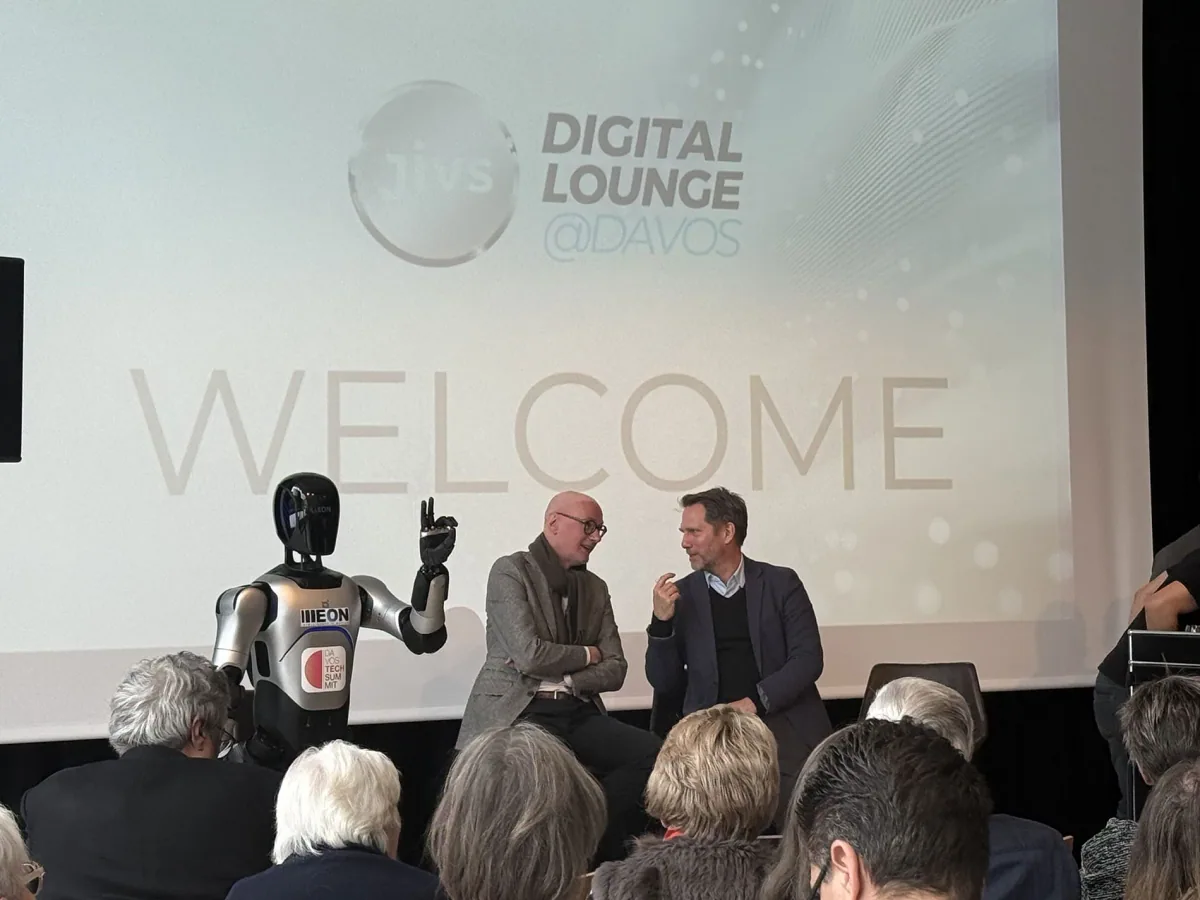
Live in Davos
Almost every question we were asked at Davos was operational: what it costs to run, who maintains it, what happens when it fails, and who is liable while it is walking around.
Nobody asked how many degrees of freedom it has. That is a different set of questions from the ones this technology used to attract, and a considerably more useful one.
- The liability question is the one worth answering first
- , because it has a legal answer rather than an opinion. Whoever places a machine on the European Union market is the importer, and the conformity file, the technical documentation and the correspondence with market-surveillance authorities sit with them. Import a machine directly from outside the Union and that is you. Buy from a supplier who has already placed it on the market and it is not. There is no harmonised European standard for a free-walking general-purpose humanoid yet, and the Machinery Regulation becomes mandatory on 20 January 2027, so this is not a question that gets easier by waiting.
- What it costs to run
- is mostly not the purchase price. It is engineering days to make the machine do your task rather than a task, the safety assessment and its sign-off, operator training, and the spares and service arrangement afterwards. The hardware is the expensive line and the one people fixate on, but a machine that cannot be told what to do in the vocabulary of your process is an expensive demonstration.
- What happens when it fails
- deserves a specific answer rather than a reassuring one. A failed joint is a manufacturer question. A robot that picks the wrong part off a belt is the integrator's, and there is nobody for them to point at. Buying through a dealer with no relationship to the manufacturer tends to leave that line undrawn, and where it falls becomes clear only after something has already gone wrong.
- Who maintains it
- should come with a number attached. A response window, not a time zone. We publish ours: a named engineer replies the same working day and works remotely first, with on-site attendance set in the service agreement.
The shift in the questions is the interesting part. Two years ago this category was asked what it could do. It is now being asked what it costs to own, which is what happens when a technology stops being interesting and starts being bought.